If you look something up on Google, chances are you will encounter an AI Overview, which is an AI-generated summary that can be found at the top of the results page, providing you with the gist of the topic along with links to the pages it derived information from.
In order to rank in AI Overviews, a page needs to rank in Google Search first, whether for the query itself or for related searches. An overview is built from Google’s existing search index, with sources selected by the same ranking system that orders the usual results.
However, ranking in the top five for a query doesn’t always guarantee a spot in AI Overviews. According to Google, overviews display a wider and more diverse set of links than a classic search. A page that already ranks for a specific topic is well placed to be included in overviews, as long as nothing blocks the citation.
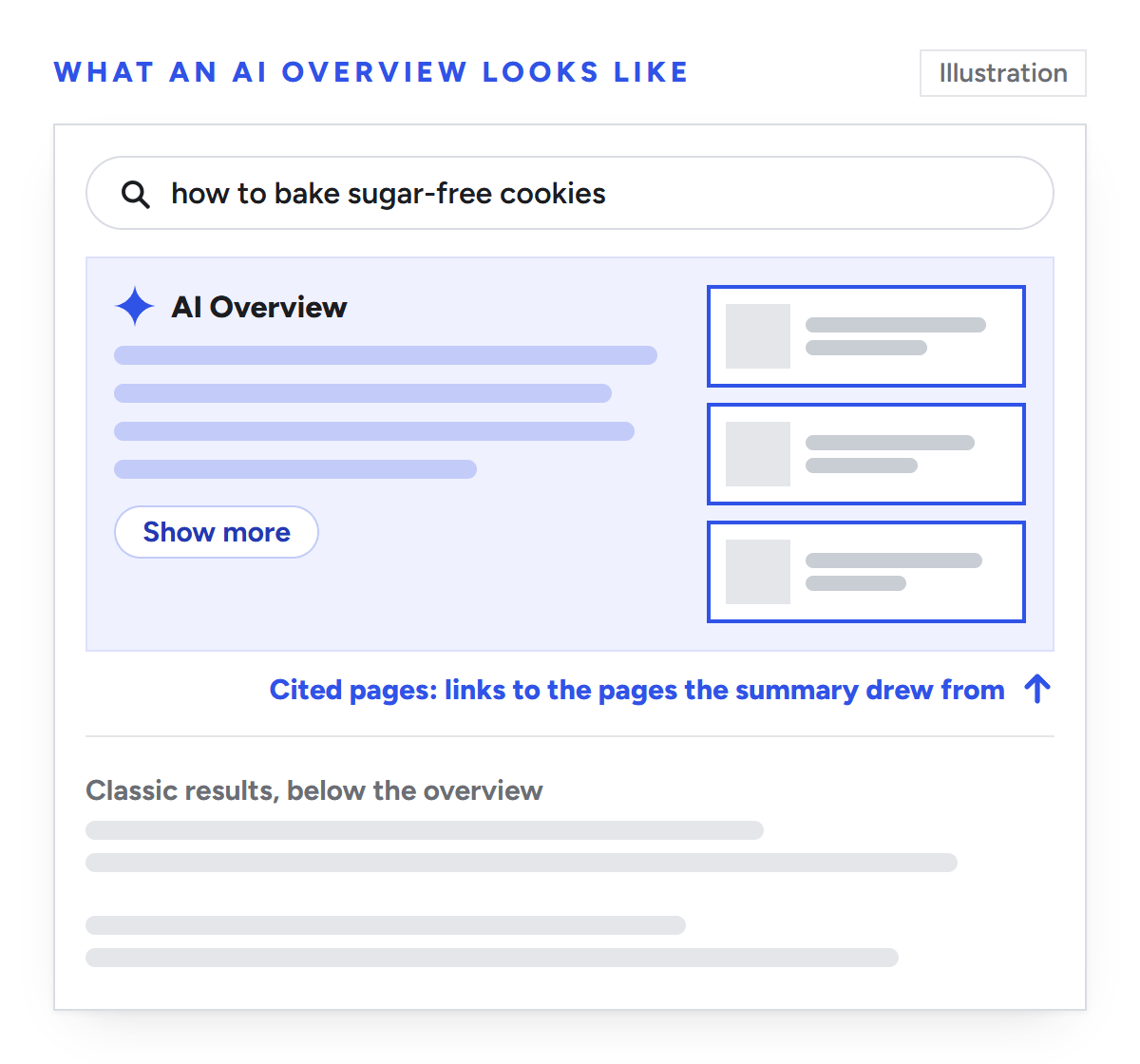
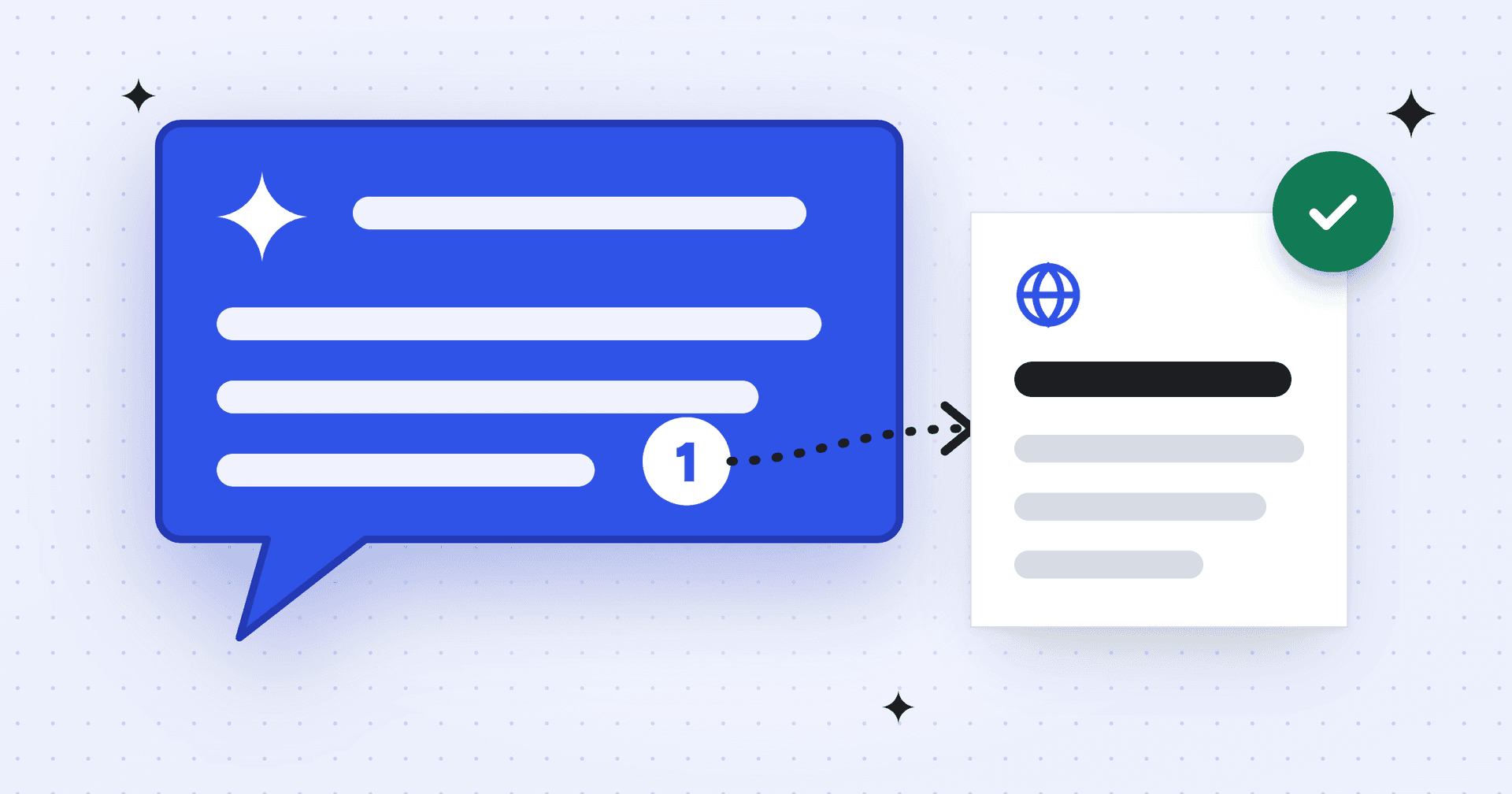
Illustration: an AI Overview sits above the classic results, with links to the pages it drew from.
How Google chooses which pages to cite
Google’s own guidance describes how its generative AI features are rooted in its core ranking systems and use retrieval-augmented generation, a process where they pull pages from the search index before summarizing them. Before it can be cited, a page must first be retrieved.
A 2026 study from Washington University in St. Louis shows how closely the two overlap. Across 7,583 AI Overviews, 70.2% of cited domains also appeared on the first page of results for the same query, while 29.8% didn’t appear on that page at all. The median overview cited eight sources, which leaves room for more than the top few results.
Google also has a basic eligibility rule wherein a page must be indexed and able to show a snippet of content, and your site needs to be included in Search generative AI features in Search Console.
What queries trigger AI Overviews?
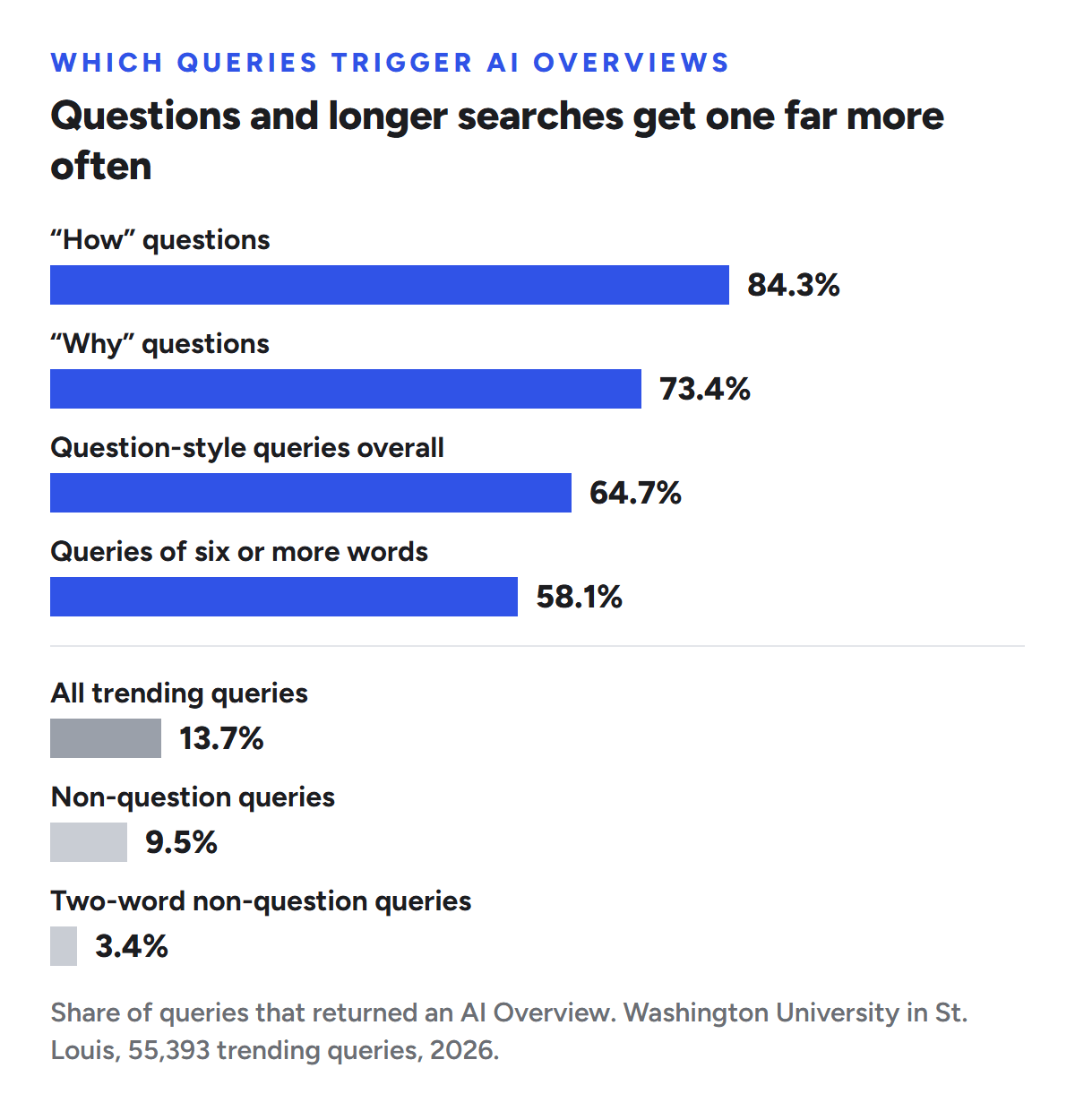
Google only shows an AI Overview when its systems decide it adds something to classic results, so many searches don’t get one. In the same Washington University study of 55,393 trending queries, 13.7% returned an AI Overview. Question-style and longer queries triggered them far more often:
“How” questions: 84.3%
“Why” questions: 73.4%
Question-style queries overall: 64.7%
Queries of six or more words: 58.1%
Non-question queries triggered an overview only 9.5% of the time, and two-word non-question queries just 3.4%. So check whether your target terms return an overview before you rework a page, especially one built around a short keyword. Step 4 of our SaaS keyword research process builds that check in.
Question-style and longer queries trigger AI Overviews far more often than short ones.
Do you know what AI Overviews say about your brand? Every SEO consulting engagement at Mission SEO tracks how ChatGPT, Gemini, and AI Overviews describe and recommend you, and the roadmap includes the changes that get you cited.
Why page length doesn’t decide citations
Google says there’s no ideal page length, and its system looks for the relevant section of a page that covers several topics. Shorter or longer pages can both work, but whether they do depends on the target audience and the subject matter.
Google’s advice is to make pages for your audience, not just for generative AI search. In practice, that means giving each page one main topic and answering it in the opening paragraphs, so readers get what they came for without scrolling.
How important is query fan-out?
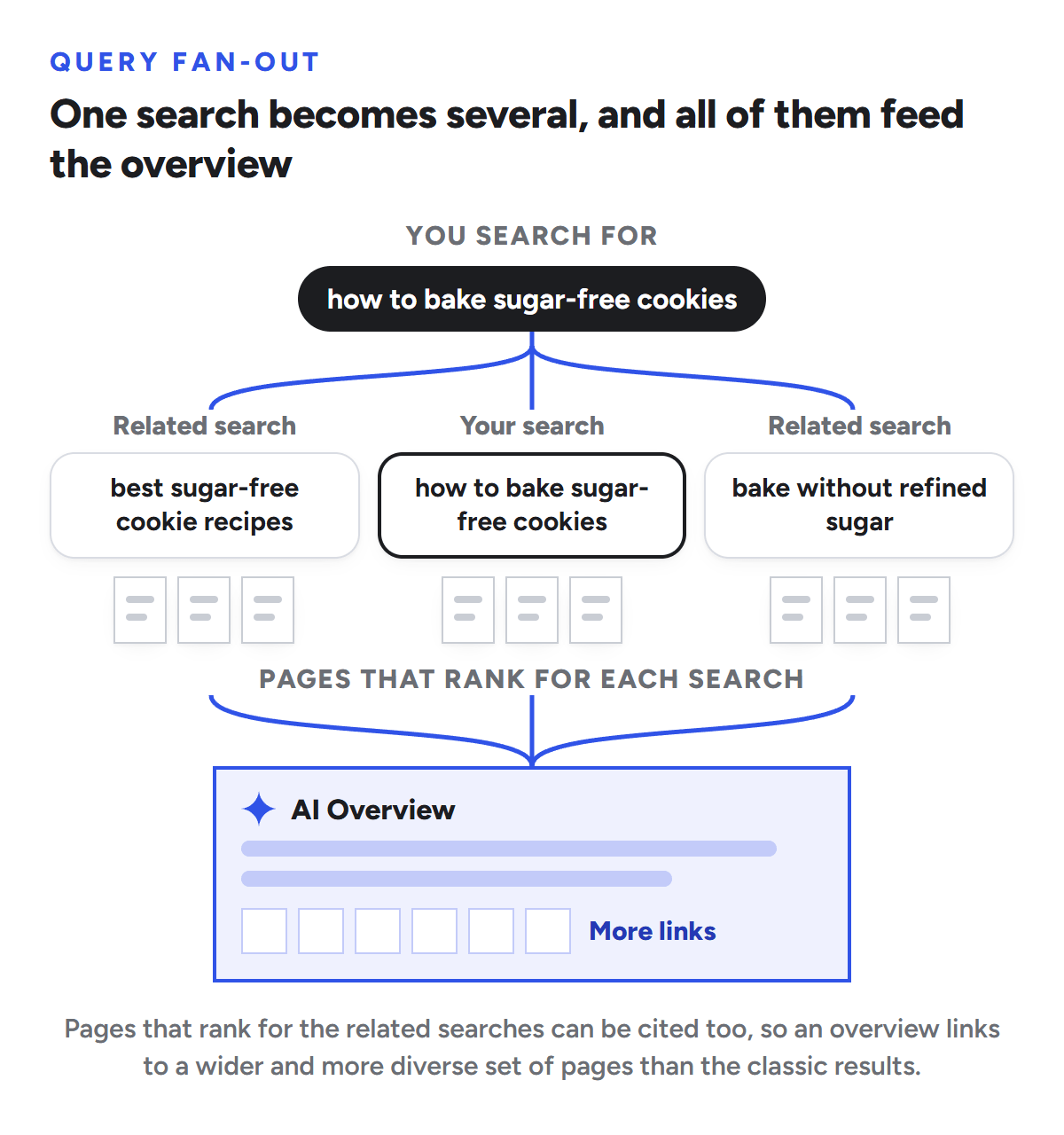
When Google generates an AI response, it runs a query fan-out. This is a set of related searches produced alongside the original. For example, you search for how to bake sugar-free cookies, and Google also issues results for best sugar-free cookie recipes and bake without refined sugar.
Ranking for those related searches matters because Google uses them to find more supporting pages while it builds a response, which is how overviews end up showing a wider and more diverse set of links than a classic search. It’s also one reason some citations come from pages beyond the first page for the original query.
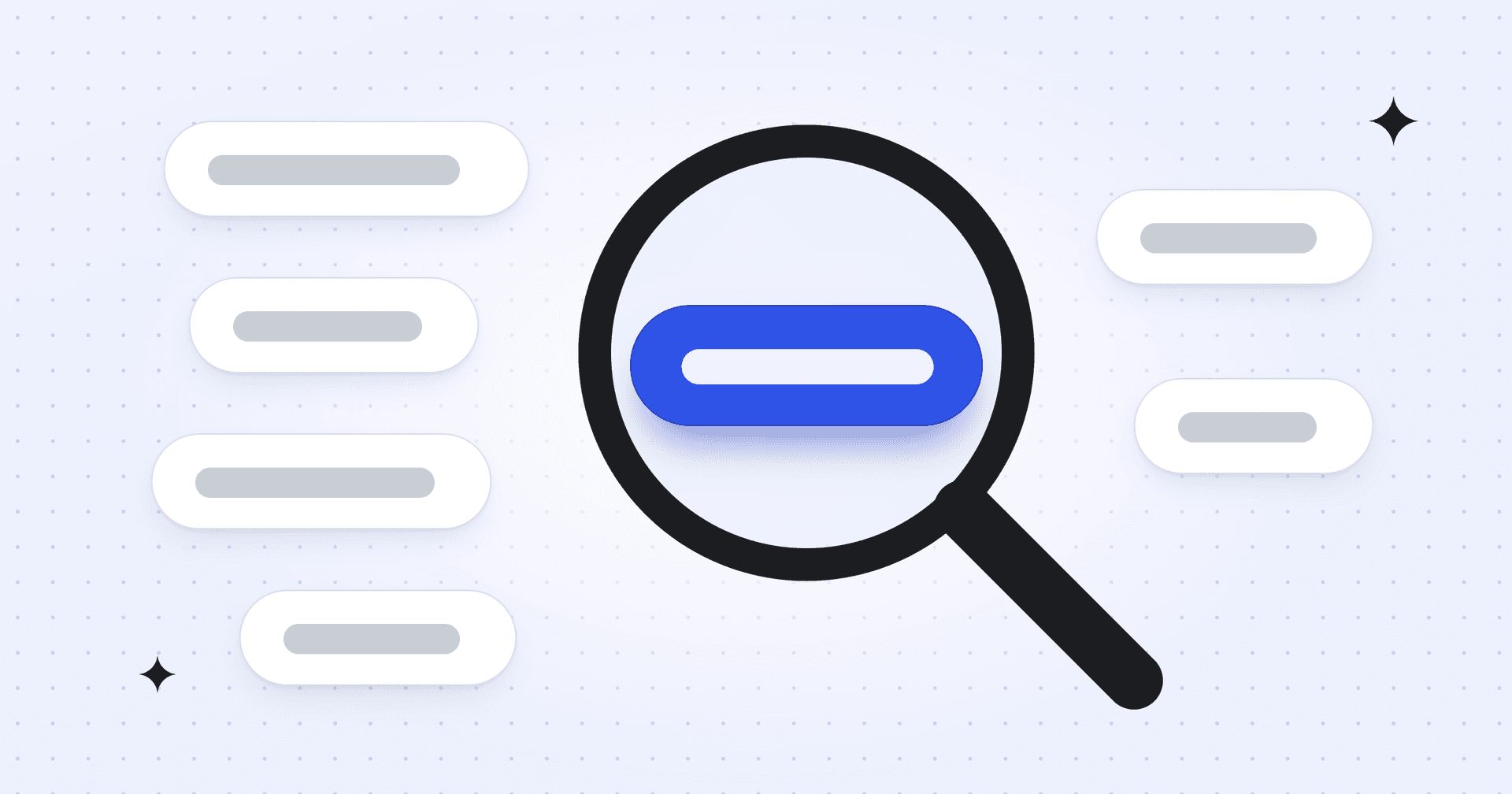
Query fan-out: pages that rank for the related searches Google runs can be cited too.
Google’s scaled content abuse policy
Now this may encourage you to optimize a separate page for every variation of a query, but according to Google, creating pages to manipulate results this way violates its scaled content abuse policy. The workaround is to include the related subtopics on the page you want cited, then back it with coverage elsewhere. Google says its AI features can show what’s being said about products and services in blogs, videos, and forum discussions across the web, so earned coverage gives your brand more places to surface.
What not to do according to Google
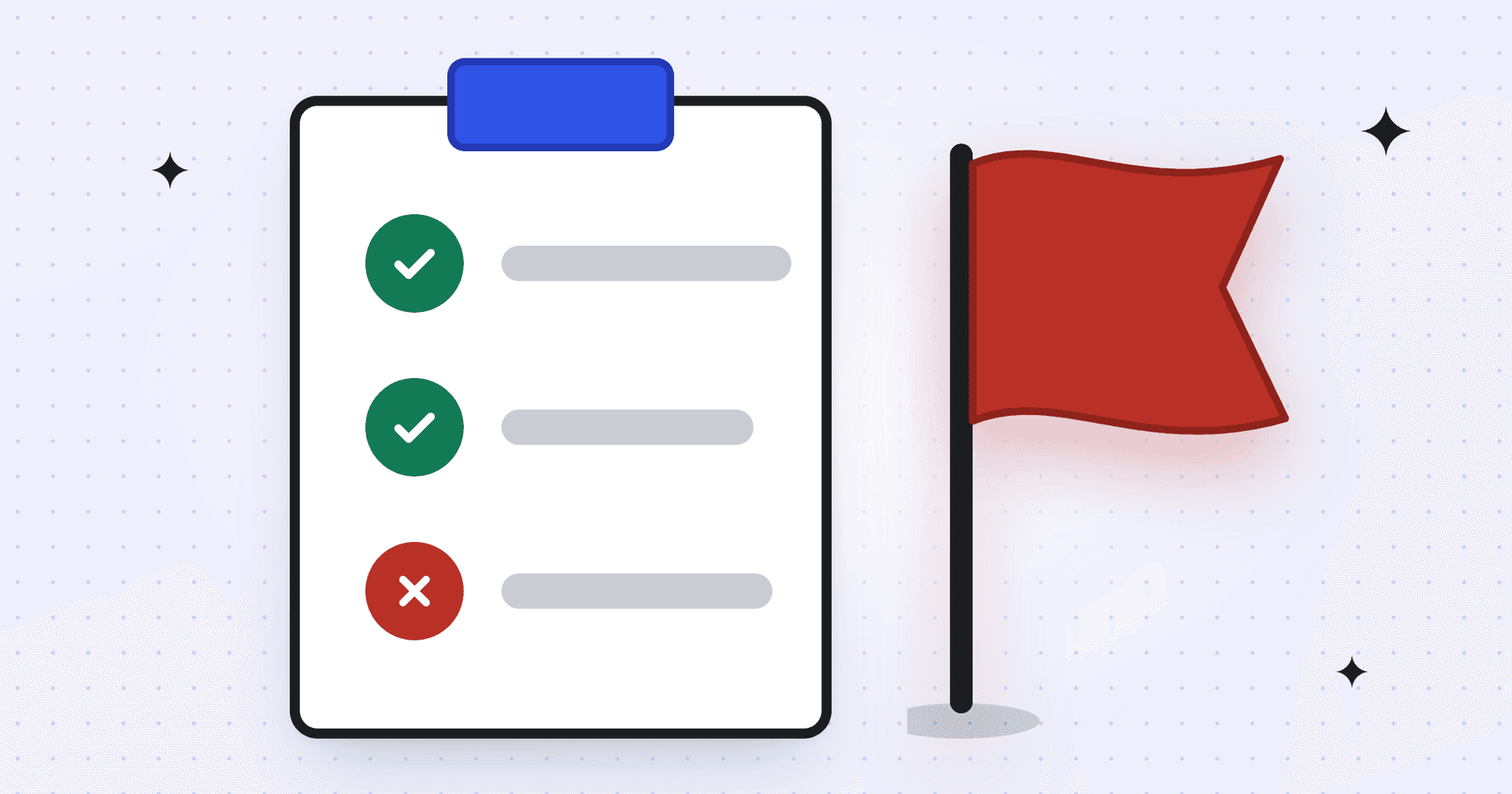
Google’s guide to optimizing websites for generative AI features outlines all the popular tactics you can ignore for Google Search as well as the key AI Overviews ranking factors. Here’s how to get cited in AI Overviews:
Google’s AI Overviews Tips
What everyone says
What Google says
What you should do instead
Add an llms.txt file
Google Search doesn’t use llms.txt or similar AI files
Put the time into indexing: submit an XML sitemap in Search Console and confirm your priority pages are indexed in URL Inspection, since a page has to be indexed and eligible for a snippet before it can appear in AI features.
Break content into chunks for AI
Content doesn’t need to be split into small pieces
Give each section a descriptive heading that matches a question your readers are asking.
Rewrite pages for AI systems
AI systems understand synonyms and intent
Add what only your team can say, such as first-hand results, original data, screenshots, or expert quotes. According to Google, unique and useful content is likely more helpful for AI visibility.
Add schema to get cited
Structured data isn’t required for AI features
Keep your existing structured data, check that it matches the visible text on the page, and validate it in the Rich Results Test so your pages stay eligible for rich results.
Seed mentions across the web
Inauthentic mentions aren’t as helpful as they seem
Publish original data or expert commentary others will cite, and post product walkthroughs on YouTube. Pew Research Center’s study found that Wikipedia, YouTube, and Reddit are the sources AI summaries cite most often.
Not sure your priority pages are indexed? A page can’t be cited until it is. Our technical SEO services find what is blocking crawling, rendering, and indexing, fix it inside your stack, and watch indexing after every release, so a new problem is caught early.
How to measure AI Overview visibility
On June 3, 2026, Google added Generative AI performance reports to Search Console and has since rolled them out to every site. The Search report counts each time a link to your page appears in AI Overviews or AI Mode, so keep the following limits in mind when you use it:
It only shows impressions
AI Overviews and AI Mode are combined, so you can’t separate the two
Its impressions are already included in the Web search type of your main Performance report
To actually measure AI Overview visibility, consider the following steps:
1. Record a baseline
Open the Generative AI performance report, set the date range to the last 3 months, and note the total impressions. If the report won’t load, the site either has too few AI impressions or is excluded under Settings > Search generative AI.
2. List the pages that appear
Open the Pages tab and click Export. The table caps at 1,000 rows, so filter larger sites to one folder, such as /blog/.
3. Find the gaps
Export the Pages tab of Performance > Search results with Average position on, keep pages at position 10 or better, and compare the two lists. Pages that rank on page one with no AI impressions are your audit list.
4. See where AI visibility comes from
Check the Countries and Devices tabs to find the markets and devices driving AI impressions, then prioritize content for the ones your sales team targets.
5. Track clicks and conversions on cited pages
Clicks from AI features are counted in the Web search type of the main Performance report. Filter Search results by each cited page, track clicks month over month, then check how those landing pages convert in your analytics.
6. Report impressions as reach
Put AI impressions next to organic clicks in your monthly report. A field experiment conducted by researchers at the Indian School of Business and Carnegie Mellon found that AI Overviews cut outbound organic clicks by 39.8% on queries where they appeared, so impressions capture exposure that clicks alone miss.
Google points out that clicks from results pages with AI Overviews are higher quality, meaning visitors are more likely to spend more time on the site, and it suggests tracking time on site and conversions in Google Analytics alongside Search Console. Compare engagement time, signups, and sales on your cited pages against your other organic landing pages to see whether that holds for your site.
Want to see your AI visibility beyond Google? Search Console only reports on Google’s own AI features. Our SEO for B2B SaaS program tracks your share of voice across ChatGPT, Gemini, and Claude against your rivals, prompt by prompt, every week. Talk to a senior consultant; the first call is free.
Frequently asked questions
Can you opt out of AI Overviews without losing organic rankings?
Yes. In Search Console, adjust Settings > Search generative AI to exclude your site. Google says the setting isn’t used as a ranking signal for regular results, but excluded sites get no traffic or impressions from AI Overviews, AI Mode, or generative AI features in Discover.
Is AEO or GEO different from SEO?
Not according to Google. Its guidance says that optimizing for generative AI search means optimizing for the search experience, so it’s still SEO. Google’s generative AI features rely on the same ranking and quality systems as regular search. For what earns citations across ChatGPT, Gemini, and other answer engines, see our answer engine optimization best practices.
Can Search Console show clicks from AI Overviews?
No. The Generative AI report shows impressions only, and clicks from AI features stay blended into your main Performance report. Compare the two reports to find pages that earn AI visibility without matching clicks.
Want to start ranking in AI Overviews?
AI Overviews reward the same work that earns organic rankings, aimed at the queries that trigger them and the related searches Google runs in parallel. Teams that do that work put their pages in front of an audience Google puts at more than 2.5 billion people per month (with Search Console impressions to show for it every month), and avoid investing in strategies that Google says they can ignore.
Mission SEO helps B2B SaaS companies grow across Google search, paid search, and AI answer engines. If you’d like a second set of eyes on your AI Overviews optimization plan, get in touch with our team.
Disclaimer: This article is based on Google’s public documentation and published third-party research available as of October 2026. It is not a guarantee of results. Google updates its AI features often, so some information could become outdated. Check Google Search Central for the latest guidance before making changes to your site. If any information is missing or out of date, please contact us.
We’re a B2B SEO and AEO agency. Book a free 30-minute call with a senior consultant: we look at your site before we talk, so you leave knowing what to fix first.



 best project management software