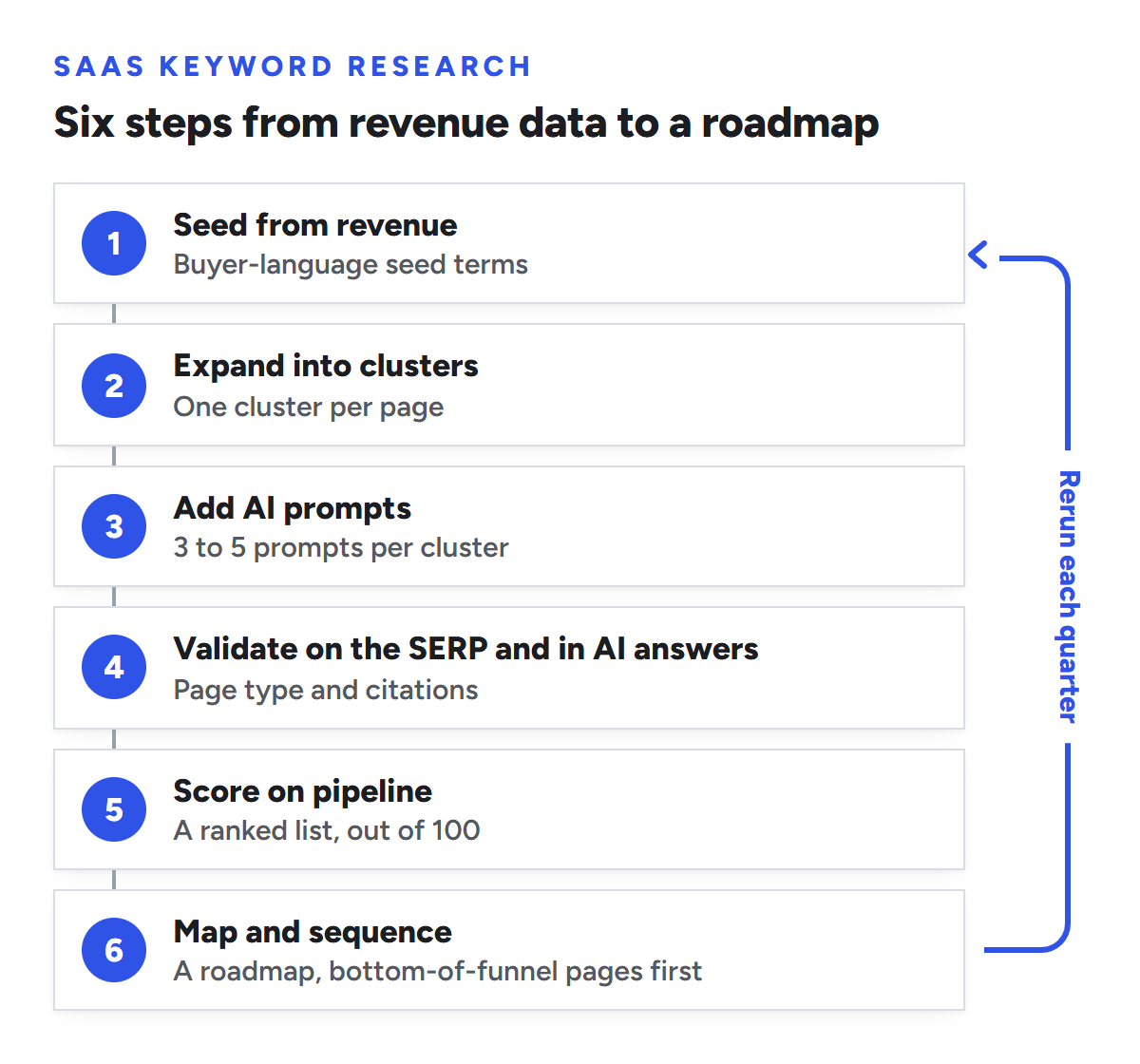
SaaS keyword research follows six steps. Pull seed terms from CRM deals and sales calls, expand them into keyword clusters, add the AI prompts buyers type, validate each cluster on Google and in AI answers, score it, and map the top scorers to a publishing order. Each step below covers the tools to use and the result to expect.
How much should search volume count in SaaS keyword research?
Use search volume to size demand and to break ties between clusters with similar pipeline scores. Four recent studies show how loosely volume tracks clicks, signups, and where buyers start research.
Fewer than one in three US Google searches sent a click anywhere in early 2026, based on SparkToro’s analysis of Similarweb clickstream data.
Keywords that trigger an AI Overview show a 58% lower click-through rate for the top-ranking page, up from 34.5% in the April 2025 version of the study, per Ahrefs research.
AI search sent Ahrefs 0.5% of its traffic and 12.1% of its signups over 30 days, according to Ahrefs’ own analytics.
51% of B2B software buyers now begin software research in an AI chatbot more often than in Google, according to G2 survey data reported by Demand Gen Report.
What access you need for SaaS keyword research
SaaS keyword research draws on five sources, covering deal records, buyer conversations, search and analytics data, a keyword tool, and AI assistants. Request access to each before Step 1, since most of them sit in systems owned by sales, RevOps, and marketing.
Read access to deal records in HubSpot or Salesforce
Access to sales call recordings and support tickets
Full user access to Google Search Console and GA4
An Ahrefs or Semrush account
ChatGPT, Claude, and Gemini accounts
How to do SaaS keyword research in 6 steps
Each step produces an output the next step uses, so a content lead, an SEO, and a RevOps owner can split the work.
Each step’s output feeds the next, and the loop reruns every quarter with fresh CRM and Search Console data.
Rerun all six steps each quarter with the latest CRM and Search Console data.
1. Pull seed terms from revenue data
Start with the words buyers used before they paid. Export the last 12 months of closed-won deals from HubSpot or Salesforce with their first landing pages, then pull recurring phrases from sales calls and support tickets. Add your G2 categories, since G2’s July 2026 buyer survey found review sites (38%) and AI chatbots (37%) were the top two influences on shortlists. Finish with Search Console queries for pages that already convert.
The step is done when you have a seed list in buyers’ own words, with each term tagged by its source.
2. Expand seeds into clusters
Run the seeds through Ahrefs Keywords Explorer or the Semrush Keyword Magic Tool, then run a Content Gap or Keyword Gap report against the domains of two to four competitor vendors. If paid search is live, the Google Ads search terms report shows which queries already convert. Group keywords that share an Ahrefs parent topic or the same top-ranking URLs into one cluster, and plan one page per cluster.
This step produces a spreadsheet of keyword clusters, each with a head term, combined search volume, and one planned URL.
3. Add the prompt layer
Rewrite each cluster as three to five buyer prompts that include context such as company size, stack, and budget. Prompts written this way run long, and ChatGPT prompts averaged 23 words in a Semrush study. Run each prompt in ChatGPT, Claude, and Gemini with ChatGPT memory turned off or in a Temporary Chat, and log every brand and domain each answer cites. Our answer engine optimization best practices cover how to earn those citations.
Keep three kinds of claims separate while you work.
Google documents that AI Overviews and AI Mode may use query fan-out, issuing related searches across subtopics to build a response.
Semrush’s clickstream analysis found that only 30% of ChatGPT prompts fit the informational, navigational, commercial, or transactional intent types used in keyword research.
Covering a buyer’s sub-questions probably raises the odds of retrieval, which is an inference no engine has confirmed.
4. Validate on the SERP and in AI answers
Search each cluster’s head term on the live SERP and record the page type that ranks, whether an AI Overview appears, and which domains it cites. Log rankings and citations as separate data points. Ahrefs’ 2026 study of 863,000 keywords found that 38% of pages cited in AI Overviews also ranked in the top 10 for the same query, down from 76% in its July 2025 study. Ahrefs also changed its parsing method between the two studies.
5. Score clusters on pipeline potential
Score every cluster from 1 to 5 on five criteria, multiply each score by its weight, add the results, and multiply by 20 for a total out of 100.
Pipeline scoring rubric
Criterion
Weight
Scores 1 when
Scores 5 when
Product fit
30%
The product is loosely related
The product solves this exact problem
Buyer stage
25%
The searcher is learning a concept
The searcher is comparing or choosing vendors
Conversion evidence
20%
The phrase never appears in the CRM or on calls
The phrase appears in won deals or sales calls
Winnability
15%
Top results far outrank your site’s authority
Ranking pages are thin, dated, or beatable
AI-answer presence
10%
No AI answer appears
AI answers appear and cite third-party pages
These weights suit a pipeline goal. Agree on them before scoring starts and keep them fixed for the full round. When two clusters land within five points of each other, build the higher-volume cluster first.
6. Map clusters to page types and sequence them
Give clusters one page each, matched to the page type that ranks in Step 4, so two URLs don’t compete for the same cluster. Build bottom-of-funnel pages first (alternatives, comparisons, pricing, and integrations), then the guides that link into them. Add the clusters to the content calendar with their page type and target date, at a pace the team can publish and maintain.
The result is a publishing order the team can follow without reopening priorities each week.
Worked example of scoring SaaS keyword clusters
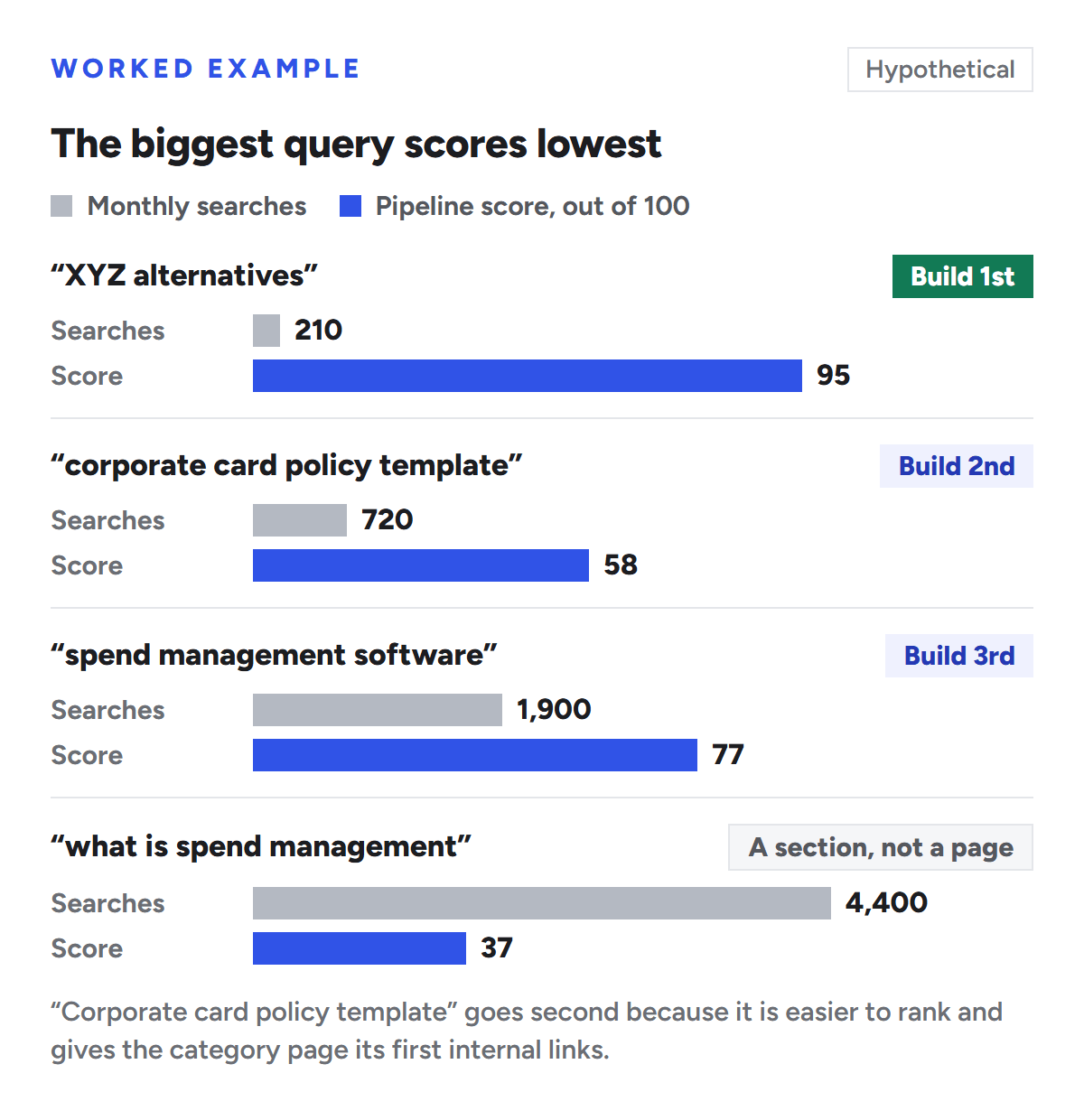
The product here is a hypothetical spend-management platform for mid-market finance teams, and XYZ stands in for a competitor vendor.
Worked example scores
Cluster
Volume
Fit
Stage
Evidence
Winnability
AI
Score
“XYZ alternatives”
210
5
5
5
4
4
95
“spend management software”
1,900
5
4
4
1
4
77
“corporate card policy template”
720
3
2
3
4
3
58
“what is spend management”
4,400
2
1
1
2
5
37
The “XYZ alternatives” cluster scores highest because its searchers have already chosen the category, are weighing a switch, and use the same phrase in won deals. “Spend management software” scores well on fit and stage, and its winnability score of 1 means it needs supporting pages linking into it before it can rank. The definition query scores lowest on pipeline potential, and an AI Overview is likely to answer many of those searches on the results page.
That sets the build order as the alternatives page, then the policy template, then the category page with the definition covered as one of its sections. The template ships before the higher-scoring category page because it is easier to rank and gives the category page its first internal links.
In the worked example, the highest-volume query scores lowest, and the build order follows score and winnability, not volume.
No one free to run all six steps? Our SEO for B2B SaaS program runs them with you: research and an audit sorted by buying stage in weeks one and two, a roadmap ranked by pipeline potential in weeks three and four, then comparison, alternatives, and use-case pages shipped in months two and three.
Common SaaS keyword research mistakes and how to fix them
Each mistake below weakens a specific part of the process, from the seed list to the monthly report. The fixes rely on tools already covered in this guide and add no new software to your stack.
Common mistakes and fixes
Mistake
Fix
Building a separate page for every close keyword variant
Cover the variants on one page per cluster. Google’s scaled content abuse policy targets pages made mainly to manipulate rankings.
Sizing demand in the wrong market
Set Ahrefs or Semrush to the countries your sales team covers before pulling volumes.
Counting brand searches in cluster results
Use Search Console’s branded queries filter to report non-branded performance for each cluster.
Scoring clusters without sales or RevOps input
Fill the conversion evidence column with the people who own the CRM and call recordings.
How do you know your SaaS keyword research worked?
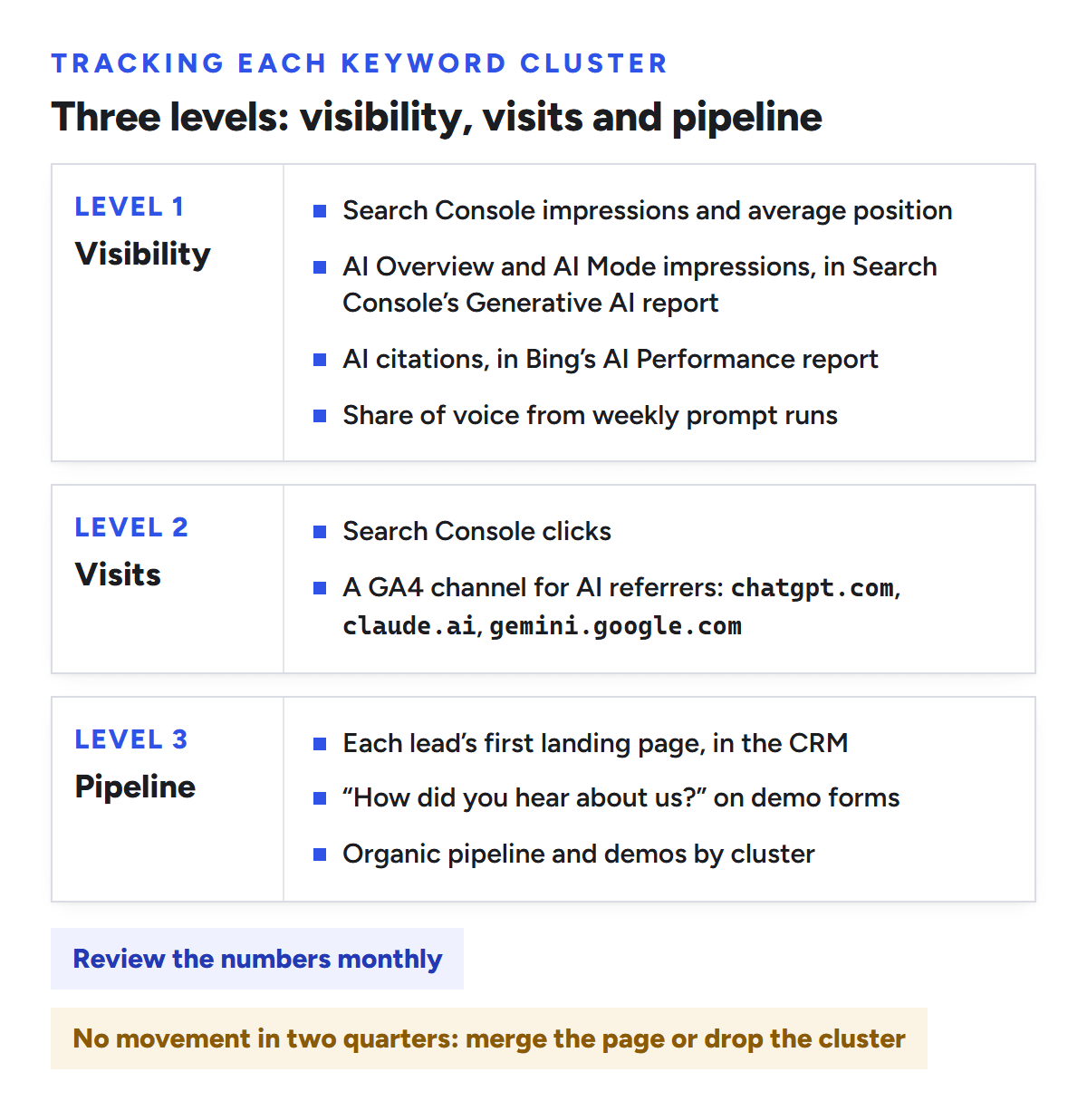
Track every cluster at three levels (visibility, visits, and pipeline) and review the numbers monthly.
Track every cluster at three levels each month, and merge or drop one that hasn’t moved in two quarters.
Before publishing, record a Search Console baseline of impressions, clicks, and average position for the target queries.
Check AI Overview and AI Mode impressions in Google’s Generative AI report, which Search Console added on June 3, 2026. The report covers impressions by page, device, and date with no click data, which makes it a reach measure.
Check how often AI answers cite your pages in Bing Webmaster Tools’ AI Performance report, in public preview since February 2026.
Repeat the Step 3 prompt runs weekly and chart how often your brand is named or cited next to competitor vendors. A rising share of voice shows the pages are reaching AI answers.
Group AI referrers (chatgpt.com, claude.ai, gemini.google.com) into their own GA4 channel, pass each lead’s first landing page into the CRM, and add a “How did you hear about us?” field to the form on your SaaS book a demo page.
Report organic pipeline, organic demos, and AI citation counts by cluster next to rankings.
If a cluster shows no movement in impressions, citations, or pipeline after two quarters, merge its page into a stronger one or drop the cluster.
Want every page judged by the pipeline it brings? That is how we report on SaaS SEO. We connect Search Console and analytics to your CRM, and track your share of voice in ChatGPT, Gemini, and Claude against your rivals, prompt by prompt, every week. Talk to a senior consultant.
Make the content roadmap easy to defend
A scored cluster list gives marketing leaders a way to explain roadmap choices with numbers finance already tracks. When leadership asks why an alternatives page ships before a broader guide, the answer is its rubric score, backed by the demos and revenue the page goes on to produce over the next two quarters. The same record shows which bets paid off when the next planning cycle starts.
Deciding whether to run keyword research in-house? Start with a free, no-obligation call with a senior consultant who has looked at your site beforehand. We’ll show you the searches your buyers make before they choose a tool and who is winning them today, and you’ll leave with the first three things we’d fix. Pick a time that suits you.
Frequently asked questions
Should SaaS companies target bottom-of-funnel keywords first?
Most SaaS companies should, and a new software category is the main exception. When few buyers search for the category name, educational content has to establish the problem before alternatives and comparison pages have an audience. Track impressions for category terms in Search Console and add bottom-of-funnel pages once that demand starts to show.
Does SaaS keyword research change for product-led companies?
Yes, mainly in where the conversion evidence comes from. Product-led companies should score conversion evidence from signup and activation data in their product analytics, and measure results in trials and activated accounts. The rest of the process stays the same.
Should SaaS companies target other vendors’ brand names?
Yes, through alternatives and comparison pages for queries such as “XYZ alternatives” or “XYZ vs.” followed by your product name. Describe the other product accurately, cite its public pricing or documentation where you can, and show the date the page was last updated. Review each page whenever the other vendor changes its pricing or features, since outdated comparisons undermine the page’s credibility.
Disclaimer: This article is based on public documentation and third-party research available as of October 2026. Search features, AI assistants, and their reports change often. Check the linked sources before acting on a specific setting or number.
We’re a B2B SEO and AEO agency. Book a free 30-minute call with a senior consultant: we look at your site before we talk, so you leave knowing what to fix first.


 best project management software